
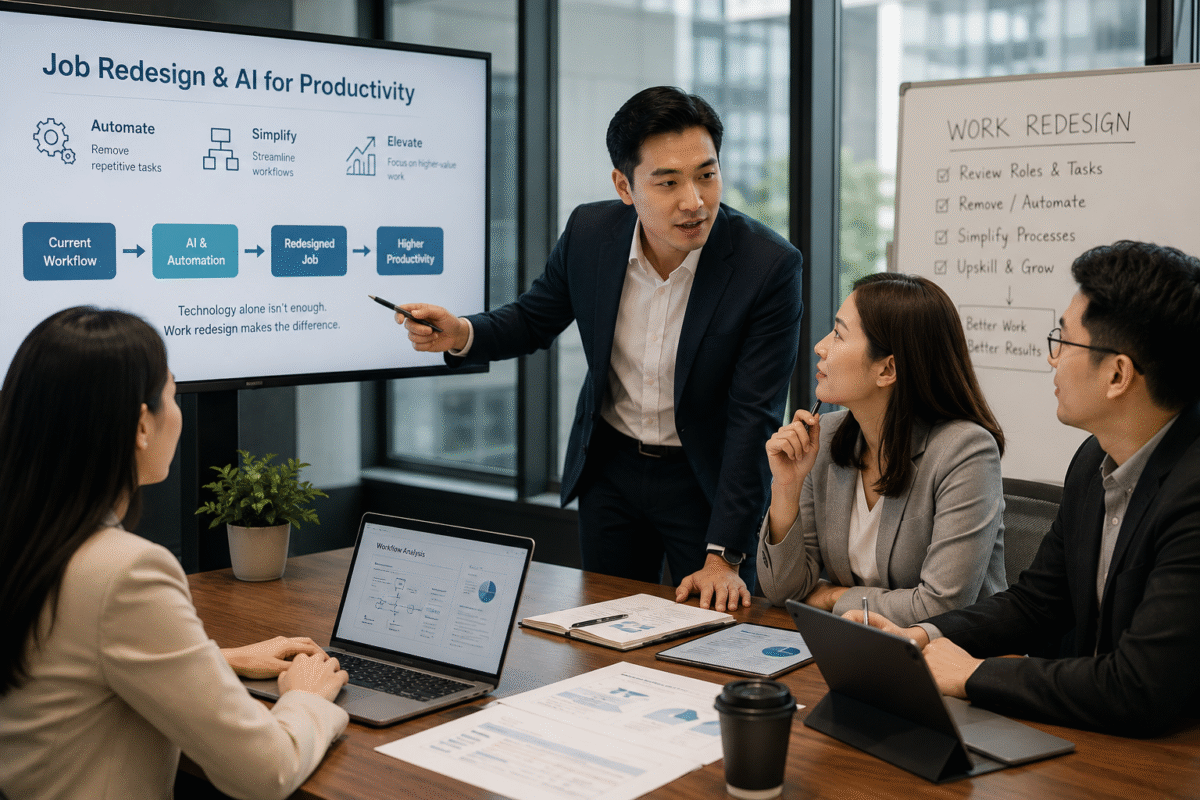
Job redesign in Singapore is becoming increasingly important as companies explore AI tools, automation, and workforce transformation to improve productivity.
Across industries, more businesses are using AI for reporting, recruitment, customer service, HR operations, finance, marketing, and workflow automation. But after the initial excitement, many leaders face the same issue:
The company has adopted new tools, but productivity has not improved as much as expected.
This usually happens because AI tools alone do not fix the way work is done.
If workflows are still messy, job scopes are unclear, and employees are expected to work in the same old way, AI becomes just another layer on top of an inefficient process.
That is why job redesign matters.
What Is Job Redesign?
Job redesign is the process of reviewing and restructuring job roles, tasks, workflows, responsibilities, and skills requirements to improve productivity and business outcomes.
In the context of AI and automation, job redesign helps companies understand how work should change when technology is introduced.
It helps businesses answer questions such as:
- Which tasks should remain human-led?
- Which repetitive tasks can be simplified or automated?
- Which workflows should be redesigned before technology is introduced?
- Which job roles need to evolve?
- What new skills do employees need?
- How should productivity be measured after work is redesigned?
For Singapore companies, job redesign is especially relevant as businesses face rising costs, manpower constraints, and pressure to build a more future-ready workforce.
Why AI Tools Alone Do Not Fix Productivity
Many companies start their transformation journey by asking:
“What AI tool should we buy?”
But the better question is:
“What work should we redesign first?”
AI tools can only create value when they are introduced into a workflow that makes sense.
For example, a company may introduce an AI reporting tool, but employees still need to manually clean the data, check the numbers, format the report, and explain the insights.
A customer service team may introduce a chatbot, but if the internal knowledge base is outdated, the chatbot may still give incomplete or inconsistent responses.
A HR team may use AI for recruitment support, but the hiring workflow may still be slow if approvals, job requirements, and evaluation criteria are unclear.
In each case, the issue is not only the AI tool.
The issue is the job design and workflow behind the tool.
That is why AI adoption should not be treated as a standalone technology project. It should be part of a wider workforce transformation and job redesign strategy.
The Real Productivity Problem Is Often Hidden in the Workflow
When productivity is low, many companies assume they need more manpower, stricter supervision, or better software.
But very often, the real problem is hidden in the workflow.
Employees may be spending too much time on manual reporting.
Managers may be tracking work across too many spreadsheets.
Teams may be chasing approvals through email, WhatsApp, and shared folders.
HR, finance, sales, and operations teams may be doing repetitive coordination work that could be simplified or automated.
In these situations, hiring more people may not solve the problem. It may simply add more people into the same inefficient system.
Job redesign helps companies step back and review how work is done. Instead of only asking employees to work harder, companies can identify which tasks should be removed, simplified, automated, or redesigned.
Signs Your Company May Need Job Redesign
Your company may benefit from job redesign if:
Your employees spend too much time on repetitive work.
Your company has AI tools, but adoption is low.
Managers still rely on manual tracking and spreadsheets.
Teams are busy, but output is not improving.
Technology has been added, but work has not changed.
These signs often show that the issue is not only manpower or technology. The issue may be how the job is designed.
Job Redesign Helps Employees Move Into Higher-Value Work
The goal of job redesign is not simply to remove tasks.
The stronger goal is to help employees move toward higher-value work.
If AI can support basic report generation, employees can spend more time analysing the results and recommending business actions.
If automation reduces repetitive data entry, employees can focus more on customer service, quality control, or process improvement.
If AI helps prepare first-draft proposals, marketing content, or recruitment summaries, employees can spend more time refining strategy, improving accuracy, and strengthening client communication.
The question is not only:
“What can AI replace?”
The better question is:
“What higher-value work can employees focus on when repetitive tasks are reduced?”
This is where job redesign can create more sustainable productivity improvement.
How WDG(JR+) Can Support Job Redesign Projects
For eligible Singapore enterprises, the SkillsFuture Workforce Development Grant (Job Redesign+), also known as WDG(JR+), provides support for workforce transformation and job redesign projects.
This can help companies lower the cost of reviewing workflows, redesigning job roles, building workforce capability, and exploring suitable workforce technology solutions.
With the right support, companies can take a more structured approach to job redesign:
- Diagnose the current workflow problem.
- Identify job roles affected by AI or automation.
- Redesign work processes and responsibilities.
- Map the skills employees need.
- Explore suitable workforce technology or AI tools.
- Build internal capability for change.
- Measure productivity outcomes.
This helps companies treat AI adoption as part of a wider workforce transformation journey, instead of a one-off software purchase.
How Companies Can Start a Job Redesign Project
Companies that want to begin job redesign can start with a simple review of their current work processes.
First, identify repetitive tasks such as reporting, data entry, scheduling, document preparation, email follow-ups, or internal coordination.
Next, review workflow bottlenecks such as approval delays, unclear handovers, manual checks, or duplicated work.
Then, separate human-led work from technology-supported work. Some tasks require human judgment, while others can be supported by AI, automation, templates, or workflow tools.
After that, redesign job roles so employees can focus more on analysis, advisory, service quality, relationship management, problem-solving, and decision support.
Finally, build employee capability and measure whether the redesigned workflow improves time savings, output quality, service speed, productivity, or business performance.
The Companies That Win With AI Will Redesign Work First
AI is changing how businesses operate.
But the companies that win with AI will not simply be the companies that buy the most tools.
They will be the companies that redesign work properly.
They will know which processes to simplify, which tasks to automate, which roles to redesign, and which skills to build.
A better tool placed into a poor process will still produce limited results.
But when AI is combined with proper job redesign, companies can unlock stronger productivity, better workforce capability, and more sustainable business growth.
Is Your Business Ready for Job Redesign?
If your company is exploring AI, automation, workforce transformation, or productivity improvement, now may be the right time to review your job roles and workflows.
Ask yourself:
- Which tasks are taking too much time?
- Which teams are overloaded with repetitive work?
- Which workflows still depend heavily on manual coordination?
- Which job scopes need to evolve because of AI?
- Which employees need new skills to work effectively with technology?
Elitez Job Redesign+ supports companies in reviewing workforce needs, redesigning job roles, and identifying practical ways to improve productivity through workforce transformation.
Eligible businesses may also be able to tap on WDG(JR+) funding support of up to 70%, capped at S$150,000 per enterprise, to make workforce transformation more accessible.
Start with the Elitez JR+ Self-Diagnostic Tool to assess your company’s workforce readiness and identify areas for improvement.